
U.S. Priority Mail dispatch
Orders ship within 48 hours.

Samhain has no shortage of wonderful rituals. Ancestor altars, dumb suppers, offerings for the dead, candles in windows. This year, we've been thinking about another side of Samhain: its strange, in-between nature, and what kind of magic might be possible when we explore the thresholds in our own lives.
Prefer to listen? Settle in and enjoy the audio edition.
On Liminality, Thin Places & the Otherworld
I think of the energy around Samhain like that of an old woman waking from a dream in which she was a little girl, and needing a moment to remember which body she lives in.
For a few seconds, both women are there: the child with her small, unmarked hands, and the old woman with eighty-five winters in her bones. The bed is familiar, the room is familiar, but time has made a small mistake, and she has woken up inside it.
There are strange liminal moments when the world seems to forget the rules by which it ordinarily keeps things separate. Think about how a doorway belongs to two rooms, or how twilight belongs to two parts of the day. At the mouth of a river, fresh water and salt water mingle, their boundaries shifting with the tide.
A child loses a tooth and spends the next several weeks worrying the empty place with her tongue. The tooth is gone, although its replacement has yet to appear. Meanwhile, the gap has become a thing in its own right, something with edges she can feel.
Or, in a darkroom, a photograph begins to develop. First a stain, then the faint suggestion of a pair of eyes. A mouth appears, and a face slowly gathers itself out of the chemicals, belonging for a few moments to both the blank paper and the person emerging upon it.
These are liminal moments, from the Latin limen, meaning threshold: intervals in which something has ceased to be what it was, while whatever comes next has yet to acquire its shape. And Samhain, marking the passage from harvest into the dark half of the year, belongs to this family of in-between things.
In Irish folklore, Samhain is associated with a loosening of the boundaries between the human world and the Otherworld. The aos sí, beings belonging to a realm ordinarily concealed from human perception, are said to move more freely. The dead draw close to the living.
Imagine the veil between worlds becoming thinner than a butterfly's wing. How easily the powdery scales rub from a butterfly's wings onto your fingers; how something so delicate can carry a living creature for miles, and yet be damaged by a careless touch. To imagine the boundary between worlds made of something so fragile is to imagine a universe held together by surprisingly little.
We encounter these in-between states everywhere. There is a lobster hiding beneath a rock somewhere, having recently abandoned its shell. The shell remains almost perfectly convincing, complete with claws and the delicate architecture of its joints. The animal itself is soft, exposed, scarcely resembling the formidable creature it was yesterday.
Or consider a frozen pond beginning to thaw. The ice retains its familiar appearance, pale and smooth, while underneath it the water has already begun to move. It looks capable of bearing your weight, although the old rules no longer apply.
There is something unsettling about a threshold. The visible world may keep its usual appearance even after the conditions governing it have changed, and maybe that is part of what makes such moments magically interesting.
Some thresholds are places we can visit. A crossroads belongs to several directions. A shoreline is continually being claimed and reclaimed by the sea. A cave has an entrance through which daylight travels only a little way before being swallowed by darkness.
Irish tales of the Otherworld frequently locate encounters around mounds, caves, lakes and other features where an ordinary landscape seems to contain an entrance to somewhere else. There are stories of paths along the Irish border where people saw or heard things they could never explain, places from which they returned changed, although nothing visible about the landscape accounted for what had happened.
Imagine walking a familiar path one afternoon and finding that something about it has become inexplicably different. The trees stand where they always stood, the stream follows its usual course, and nothing has moved.
Yet the relationship between yourself and the landscape has altered.
Maybe the place feels outside time. The light falls strangely across the grass, and a familiar bend in the road seems to lead somewhere you have never been, although you know perfectly well what lies around the corner. Then, another afternoon, you return hoping to experience the same thing, and find the place entirely ordinary.
Some places seem to slip through our fingers. Their character changes with the hour, the weather, the season, or something within the person who encounters them. This is one of the strangest things about place: a landscape can remain physically unchanged while becoming unrecognizable to the person standing inside it. Or it can be altered almost beyond recognition and still contain the exact arrangement of light, smell or sound that returns someone to a life they thought had disappeared.
Some boundaries are drawn on maps; others become part of the people who have crossed them. A road might divide two countries without revealing the division to anyone walking across it. Yet that invisible line may have determined where generations of people could live, whom they could marry, or whether they could return home.
At Samhain, the old stories give us a season in which the familiar landscape may contain something ordinarily inaccessible. The distinction between here and elsewhere becomes less certain, and there remains the unsettling possibility that someone could encounter a thin place on an ordinary walk and never experience that same stretch of earth quite the same way again.
We carry thresholds inside ourselves too. Adolescence, pregnancy, childbirth, menopause, bereavement, ageing: the body enters unfamiliar territory, and its previous arrangements begin to change, sometimes long before we understand what is happening.
A snake swallows an egg. For a little while, its body takes on the unmistakable shape of something that belongs inside it. A dress taken apart by a seamstress lies in pieces across a table. The sleeves are detached, the bodice is turned inside out, and little triangles of fabric that once made a waist have been carefully unpicked. Everything that made the dress is still there, although for the moment it cannot be worn.
There are periods in a human life that feel like this. A marriage may have ended while the wedding ring continues to leave a pale circle on the finger. A child has grown up, although their mother still finds herself filling the fridge with the food they once loved. A person may have moved away from home, yet continue to dream of the bedroom they slept in at eight years old.
Sometimes a change has already happened, and the rest of life has yet to catch up.
Like a fly that remains alive against a November window, still conducting the business of summer, although the first frost has already killed everything it knew how to eat.
Across different cultures, people have developed rites of passage to give these uncertain intervals a recognizable form. Someone might be separated from ordinary life, undergo an initiation, and return with a new place in the community. During the interval, their previous identity no longer entirely applies, while the new one has yet to be established.
And there is something worth considering about arriving at Samhain while already inhabiting one of these thresholds ourselves. A person may continue living inside an old arrangement long after its foundations have begun to shift, or find that a former life persists inside a new one, as stubbornly as the white line left by a ring. The past is sometimes remarkably slow to depart.
And anomalies have magical possibilities. Consider a candle at the moment it goes out. The flame disappears, the wick glows red, and a thin column of smoke curls upward, retaining for a few seconds the movement of the fire that produced it. The flame has ended, although something of it continues to travel through the room.
Or imagine an old house after the death of its occupant. The slippers remain beside the bed, and a cup sits in the kitchen. Open a wardrobe and the perfume of its owner rises from the hanging clothes. The person is gone, although their presence continues to occupy the smallest things. Something can end and continue to leave its shape upon the world.
This is one reason the folklore of Samhain, with its returning dead and permeable boundaries, feels so familiar despite its supernatural strangeness. As the living, we already inhabit a world crowded with traces of the dead. Their names remain in our mouths, their handwriting survives on scraps of paper, and a familiar smell can return us to a room we haven't entered in twenty years.
Memories move through the house like silken ghosts.
Samhain gives these lingering presences a place in the calendar. And perhaps this is where its magical possibilities become most interesting: in the strange intervals when something has ended but has yet to disappear.
What might we ask of a place that belongs to two worlds? What might we learn from something that remains present after its ending? And what happens when we deliberately step into an interval in which the outcome has yet to be decided? These are questions worth carrying into Samhain.
Thresholds are places we pass through, and every crossing eventually reaches an end. The lobster's new shell hardens. The child with the missing tooth discovers another pushing through the gum. A developing photograph acquires its face. Even a frozen pond eventually becomes water again, although there is a dangerous interval when the ice still looks solid but can no longer bear a person's weight.
People have long developed rituals for passage, ways of entering uncertain territory and finding their way back. In some accounts of Samhain customs, household fires were extinguished and rekindled from a communal bonfire.
Imagine the hearths of an entire settlement going dark: the pots cooling, ash settling where flames had been, and the houses growing cold around their sleeping inhabitants. Then someone carries a flame home, and a new fire takes hold where the old one died.
I think our Samhain magic might follow a similar rhythm. A threshold is approached, a crossing made, an offering left. Then the visitor is bid farewell, the candle extinguished, the door shut. And yet, returning does not necessarily mean that everything goes back to the way it was.
A person can leave a place and continue carrying it for decades, while an encounter may last only a few minutes and change the meaning of a familiar landscape forever.
Outside, the last warmth of autumn leaves the stones. Somewhere, a moth presses its pale wings against a window. In an old house, a woman wakes from a dream of her childhood and lies still, listening to the rain. For a moment, she cannot remember whether she is eight or eighty-five.
This essay draws on the idea of thin places as explored in Kerri ní Dochartaigh's Thin Places (Canongate, 2021), particularly the relationship between landscape, memory and the boundaries between worlds.
Something in your life is changing. What if you could work a little magic upon it? A Samhain spell to draw, cast, and take with you into your dreams.
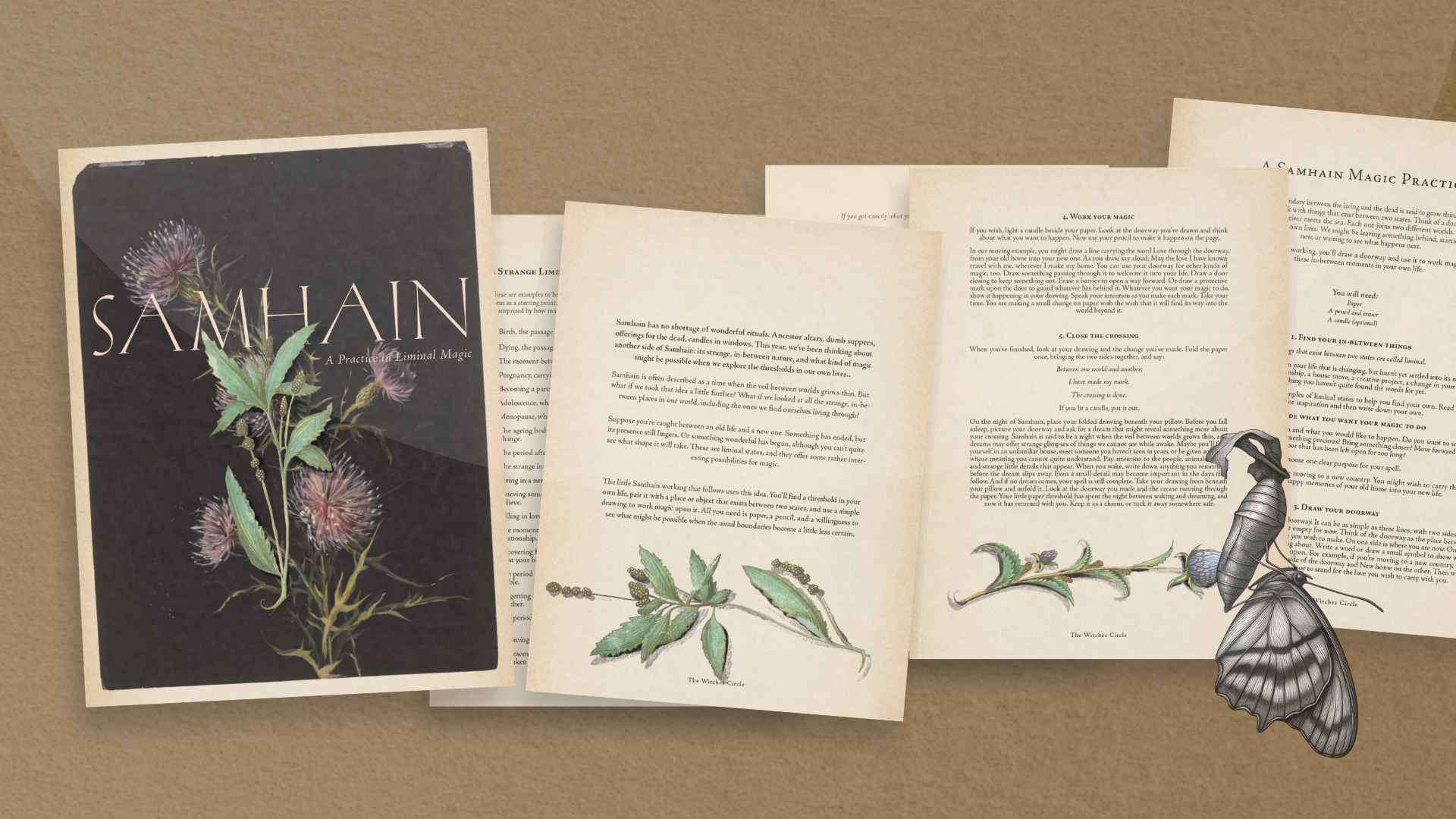
Free illustrated PDF · Save or print
For those curious about the magic behind these pages.

A beautifully illustrated book of plant and crystal magic, spells, lore and things worth knowing.
Explore the Grimoire →
New and Full Moon guides throughout the year, with rituals, divination, folklore and practical magic.
Explore the Circle →